|
The Lynx Project News...
Check here first for late breaking news on the missing L-M Dream Car
March 2016:
We apologize for not having posted to this site for a couple of years. The project has been progressing brilliant but there’s been no enough time to update this site. Please check out the following items:
Our list of project participants has changed with the retirement of a person or two, and the
appearance of some new world-class craftsmen. Check out the new list of craftsmen found here.
Given the rapid progress in our Project, we’ve made the decision to present the completed Project at the 27th (2019) GSL International Scale Vehicle Championship and Convention in Salt Lake City.
We made our first “public” presentation of The Lynx Project at the twenty-fifth Anniversary GSL Championship in 2015 in Salt Lake City. In this display, we laid out most (but not all) of the scale vehicles and non of the incredible dioramas (for reasons of size and difficulty in transportation). Given the importance of the revelations of this project, and the enormous work already rendered by the world-class craftsmen for the Project, it was time to introduce the public to the Project. Go here for a photo survey of the presentation, and go here to see a special booklet (to introduce and describe the Project) that we handed out at GSL.
Ultimately, we hope to place the Lynx Project (after its public debut) in the International Model Car Builders’ Museum). As things are presently, though, for the foreseeable future, the Museum doesn’t have enough room to properly host the Project. Therefore, Mark S. Gustavson had a building constructed in the back yard of his home – in a size large enough to host the Project and present it from damage. While the structure is finished, more work is underway inside to build the table tops, display cases, and research and archival places where the project can be preserved and protected. Here are some photos of the initial construction. As the interior is finished, those additional photos will be uploaded here.
March 2014
The restoration and repair of the four factory Lynx concept cars continues after the discovery, in 2007, of three of the four long-lost Lincoln-Mercury prototypes in a Indiana warehouse (owned by one of L-M chief Mills’ brothers) where they had been placed in 1965 to protect them from the Ford corporate “destroy the prototypes” order. The other prototype was found in the home garage of Mill’s nephew whose father owned the warehouse where Mills secreted three of the Lynx prototypes, with the other car going to the home of his nephew where it had been had been parked, covered and occasionally started, since 1965. Mills’ nephew inherited the warehouse, and everything in it, as well as the fourth prototype in his home garage.
In 2008, Mill’s nephew sold to The Lynx Project, an investor group in Salt Lake City, Utah, the four prototypes cars, the until-2008-unknown Mustang Vivace and Mustang Pegasus, together with a truckload of memorabilia to a group of investors that were retrieved from the warehouse, the garage, and everything associated with the suppressed story of the “lost” Lincoln-Mercury prototypes. One condition of the sale of the Lynx cars and everything else was the requirement that The Lynx Team finally “tell the true story” of the creation, the promotion, and eventual suppression of the Lynx prototypes. He made the point that it was crucially important to reveal the history of the cars, and what role they might have played, in the history of the Lincoln-Mercury Division of the Ford Motor Company had the cars have been endorsed and embraced, and placed into production. The official history of the Lincoln-Mercury Division , from 1961 through 1966, was expurgated from the official records of the L-M Division to suppress the records of the Lynx concept car program which had been an embarrassment to some in the upper echelons of Ford Motor Company management. The Lynx Project team agreed to these goals.
The Lynx Project exists to tell the full, unexpurgated, story of the stunning story of the Lynx prototypes – one of the most remarkable stories in the history of the American automobile. The new owners of the Lynx prototypes – two individuals with the financial ability to restore the cars – also encouraged The Lynx Project’s noted scale miniaturists to create in miniature many aspects of the newly-discovered saga of the Lynx vehicle. This website is devoted to the unfolding story of the real cars and the scale miniature project that will be presented at the Twenty-Seventh GSL International Scale Vehicle Championship and Convention in Salt Lake City, Utah in 2019.
In the meantime, what follows is just a brief description of the long-suppressed Lincoln-Mercury concept car the history of which is being replicated, in exquisite scale miniatures, in order to tell the remarkable history of this prototype series.
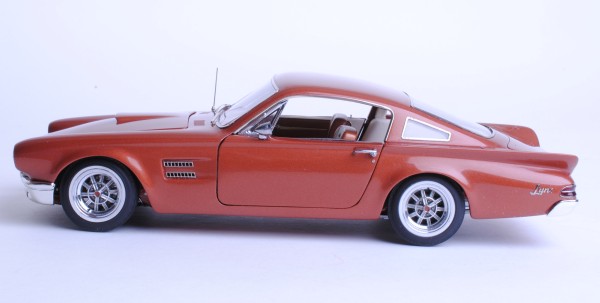
Lynx Prototype No.1 X-7
Using the real vehicle as a reference, Randy Derr built this 1/25-scale replica of the first Lynx prototype. Model was completed in early 2015 and first displayed at GSL-XXV
Factory Production VIN: 3H17F5032307
Assembly Detail: 63C A 54 20M 84 4 5
Factory Comet Build Date: 12/20/62
Received at Dearborn Steel Tubing: 12/30/1962
Dearborn Steel Tubing Build Date: 10/17/63
History of this car: Initially, there were only funds to build one prototype so Lincoln-Mercury chief Mills’ staff designed a car that they hoped would be a solid hit in the markeplace. Mills’ designers worked long hours to reconcile the early visionary drawings with the production-oriented realities that had to be achieved with this car. This V8-powered, 4-speed prototype was intended to test the market for a performance-oriented two-door sedan that would capture the attention of both the influential enthusiast press, and the larger buying public. Painted in an iridescent copper-red (another version of this color would later become a standard 1966 corporate color): this Lynx prototype was probably the most production-oriented version of the three “official” prototypes.
Completed in October of 1963, and built (by Dearborn Steel Tubing) on a ‘63 Comet hardtop platform (as were Lynx prototypes 2 and 3; L-4 would be built on the stronger ‘64 Comet convertible platform), the first Lynx prototype was a highly-finished “proof of concept” vehicle that was presented to the American auto show public and campaigned as more than just another gilded concept car. This concept car was no crudely-assembled mule barely capable of moving under its own power. Rather, this nearly production-ready prototype was designed and built to test the market appeal for a well-developed, well thought-out example of the basic Lynx design: The goal was to make a big splash in the auto show “marketplace” – in part, to overcome the too-commonly perceived staid image of the L-M Division that Mills was working hard to dispel. If the car generated positive press and public approval, Mills would use this prototype to market the entire concept car program with Ford brass (principally, Eugene Bordinat) with the goal of securing the additional funds that would be needed to build the competition car and the convertible – the other two Lynx prototypes in the official series he had envisioned.
To Mills’ enormous relief and satisfaction, this prototype was presented with much fanfare at the very prestigious February 1964 Chicago Auto Show (along with the ‘64 Durability Comets and the Super Cyclone) where it was met with enthusiastic applause from thousands of showgoers who saw a practical, stylish, performance-oriented 2+2 vehicle from the normally staid Lincoln-Mercury Division.
After the Chicago show, this prototype was trailered back to the Lincoln-Mercury studio where it was presented to visibly surprised – but still a bit skeptical – Ford brass who lauded the car’s styling and celebrated the public reaction, but secretly wondered about the effect of this stylish coupe upon the pending Mustang that would be introduced just a bit more than two months later. Ultimately, the marketing issue was one of two principal reasons the entire series of Lynx concept cars were not placed in production and were ultimately suppressed.
Leaping on the auto press’ positive notes, Mills displayed Lynx-1 in several additional shows (to ostensibly gauge public reaction), and briefly at the 1964 New York World’s Fair Ford corporate exhibit, where it appeared in the Custom Car Cavalcade along with the Ford Division’s Italien. The car also showed up at the “launch” of the Lincoln-Mercury Caravan of Stars program at Detroit’s Cobo Hall. Later, the car was seen sporadically until the early summer of 1964 (the time the second and third prototypes arrived from Bertone), whereupon it was displayed with the fully array of the prototypes at auto shows and in selected Lincoln-Mercury Caravan of Stars shows. Ultimately, this prototype was parked in Mills’ home garage (alongside Mills’ specially–styled fourth prototype) to escape the “crush the prototypes” order from Ford corporate where the car sat until it was discovered in 2007 and restored.
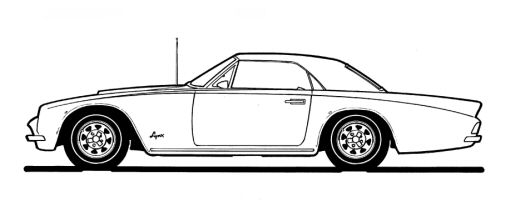
Lynx Prototype No.2 (“GT”)
Factory Production VIN: 3H17F5051431
Assembly Data: 63C M 55 6C 84 4 5
Factory Comet Build Date: 03/06/63
Received at Dearborn Steel Tubing: 3/19/63
Bertone Completion Date: Late Summer 1964
History of this car: Lincoln-Mercury Chief Mills wished to create an appealing, moderately powered, two-seat convertible to appeal to the sporty, but not genuine sports-car, crowd. The third Lynx prototype was also an attempt to revive the theme of the original two-seat Thunderbird, the revival of which had been briefly considered at the onset of the Aventurra project (that project led to the Ford X-Cars, and eventually to the Mustang). Like the original Thunderbird, a removable hardtop was fitted, the rear deck hinged at the rear-most extension of the hardtop “footprint” (ala ‘63 Corvette roadster) to reveal a completely fade-away convertible top, the mechanism of which was directly patterned after the hide-a-way system pioneered on the ‘58 Thunderbird – and to provide some small space for baggage when the soft top was retracted. Because of the design of the rear deck, there was no trunk. A 225 horsepower 4-V 289 was coupled with a modified C-4 automatic transmission, and a floor shift.
DST did the preparatory body work after which the stripped unibody platform was shipped to Italy’s famed Bertone carrozzeria for its new body.
The car was air-freighted to Mills on an Alitalia DC-8 cargo jet, arriving in very late 1965. The car was sent to Dearborn Steel Tubing for clean up and tuning (and some minor repairs), after which it was shown (along with the first prototype) with the first prototype at Lincoln-Mercury Caravan of Stars displays. In late 1965, at the end of the show season, it was retired and hidden by Mills because of the ‘crush the prototypes” edict issued by Ford legal at the time.
The second Lynx prototype was discovered in 2007 in Mills’ brother’s Indiana warehouse where the other prototypes were stored. Having been cared for and covered in a tarp, the convertible in good shape with some wonderful patina showing that has been presented.
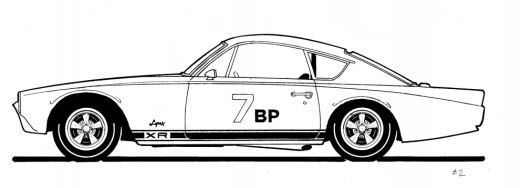
Lynx Prototype No.3 (“XR”)
Factory Production VIN: 3H17F5036943
Assembly Data:: 63C E 52 9A 84 4 5
Factory Comet Build Date: 01/09/63
Received at Dearborn Steel Tubing: 1/11/63
Bertone Completion Date: Mid Summer 1964
History of this car:
This car was finished (along with Lynx-2) at the Italian carrozzeria, Bertone, at roughly the same time as the convertible Lynx prototype was being ‘bodied” there. Also based upon a much-modified S-Prototype Mustang platform which traced its provenance to 1963 (at which time Ford delivered 15 S-prefix prototype Mustangs to DST in late summer of 1963), construction on this version was stopped, suddenly, in late 1964 when the Ford Product Planning Committee shut down the Lynx project (for several reasons to be detailed in the Lynx book).
L-M Chief Mills, upon receiving the frustrating and heart-breaking news from Ford management, direct Bertone to stop work after the aluminum body had been finished, and to return the partially-finished prototype to him. After unloading it from an Alitalia DC-8 cargo jet in late 1964, Mills had the car transported to his home where it sat in his garage for several decades.
In early 1965, Mills contacted Shelby Enterprises and ordered, essentially, all of the performance parts needed to build a Mustang GT 350R: 306-horse engine, 4-speed, overrider traction bars, early-production steel wheels, dash, gauge and suspension components. Crates containing those parts were stored in Mills garage and eventually transported to his brother’s Indiana warehouse where the cars were stored until discovered in 2007. After that, the car was completed by one of the “auto-archaeology” team to full a restoration and with all originally-intended Shelby parts installed.
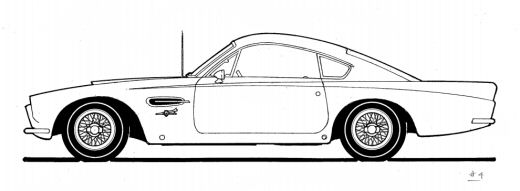
Lynx Prototype No.4 (“XR-7”) (Line drawing of Lynx-4 from Wick here).
Factory Product VIN: 4 J 25 F 500024
Factory Assembly Detail: 63C F 76 15J 34 E 1
Factory Comet Build Date: 7/25/63
Received at Dearborn Steel Tubing: 7/29/63
Bertone Completion Date: L ate Summer 1964
History of this car:
As early Lynx project work was underway in 1962, L-M chief Benjamin D. Mills determined he wanted to build his own version of the concept car series. Wise to the realities of corporate life, Mills understood that the goal of building his initial vision of his prototype car (uncompromised by the predictable presence of production considerations that he imposed on the three “official” cars) wasn’t in the cards, both for political reasons and by reasons of cost. As the mainstream Lynx project unfolded, the fourth prototype came to be the flagship for Mills’ original - and ultimate – vision of his prototype series. Interestingly, in 1969, Mills would again venture (this time, without involving the corporation at all) into the concept car world by commissioning from Bertone the construction of another Lynx-themed car – an extravagantly styled version of his first-generation Lynx prototype that was powered by a Ferrari engine.
A 1964 Comet convertible was stripped of its body and modified, generally, by Dearborn Steeling Tubing to resemble the revised platform design of the three ‘official” prototypes. That said, Lincoln-Mercury mechanical engineers devised the installation of what amounted to the front suspension from a 1960 T-Bird to the DST-modified unibody platform (the T-bird was a unibody car, after all). At about the same time, Mills turned to Klaus Arning who had developed the eventually stillborn IRS for the Mustang which shared virtually the same basic platform with the Comet upon which the fourth prototype was based; Klaus provided the components for his second generation IRS design which was never installed in a USA-production car but, in another form, ended up in the European Sierra in the mid-Eighties.
Design drawings sent to Bertone with the unibody hybrid platform included drawings and specifications to create a shortened/louvered hood. The roof differed substantially because is swept rearward in genuine fastback configuration – many later said, correctly, that this roof design was heavily influenced by, if not copied from, the Mustang Vivace which Gardner for Mills (again, based upon one of the very early S-Code pre-production Mustangs). There was no character line running down the front fender to the door; rather, the rear “fin line” dipped on the trailing edge of the door, effectively creating a “Darrin Dip.” The taillights were half round and sat atop a thin blade bumper in the underside of which – centered – was a central exhaust that echoed the setup on the first car, and directly influenced the famed Mustang Mach One show car that debuted in 1966. Finally, a functional front fender vent, that intentionally resembled the Bertone Ferrari from 1962 (Nuccio Bertone built the famed 1962 Ferrari show car for his personal use), relieved the expanse of the side of the front fender that gently rolled upward and toward the hood. A polished stainless front grille, featuring a Ferrari-esque “cross hatch” design, hosted two and integral driving lights. A think horizontal front bumper was fitted.
Mills also decided to power his personal Lynx prototype with a unique – in fact, one-off – powerplant. Long frustrated with the anemic power output of the so-called small block Ford I-6 engines, he contracted with Ak Miller (Ford’s performance consultant) to create a dual plug inline 6 with a crank-mounted S.C.o.T. blower. The engine was built in California under Ak’s direction and shipped to DST where upon it was installed in the much-modified Comet platform before the car was shipped to Bertone. Fully tunned, and hooked to a C-4 modified to match the specifications of the early Cobra roadsters some of which used the same transmission, the was broke 6 and one half-seconds to sixty which upset the V-8 crowd. Girling front disc brakes were fitted with station wagon rear brakes, all to which genuine wire wheels were fitted.
As it turned out, Lynx-4 was built along the famed bertone Mustang which was commissioned by Scott Bailey, the first and founding editor of Automobile Quarterly. In fact, the Bertone Mustang and Lynx-4 shared a return cargo flight to New York in late Summer of 1965.
Mills drove his prototype, somewhat sparingly and never to the company, for a couple of years after which it also ended up in the same Indiana warehouse as the rest of the cars. Today, the car has been cleaned up and sits in a private garage in Salt Lake City, Utah.
Here are some other details of the Lynx Project:
The Lynx Project has gathered together some of the very best builders in the model car hobby. Please go here to learn about this group:
Historical Research:
The Lynx Team continues to run across tantalizing information as it continues its investigation into the history of this most elusive of Ford Motor Company concept cars. We are cataloguing a wide array of historical photographs, L-M Division internal memos, Dearborn Steel Tubing letters to L-M Chief Mills, magazine articles, and the infamous “destroy the prototypes” letter from the Ford corporation’s in-house legal department.
We’ve also been surprised by the discovery of a box of hobby kits, replicating the fourth version of the car. The previously unknown kits bear the label of the famed Industro-Motive Corporation. Even knowledgeable model car historians don’t recall anything about what must be a very rare kit.
The Lynx Team has discovered that Andy Hotton and Vince Gardner, of Dearborn Steel Tubing, became acquainted with the Lynx Project sometime in late 1962 when approached by Lincoln-Mercury chief Benjamin D. Mills. Hotton and his company built many of the Ford corporate concept cars in that era including the Ford Galaxy Starlift, the Thunderbird Italien, the Comet Super Cyclone and the Comet Escapade as well as the Fairlane Thunderbolts. And the company did all of the basic Comet unibody re-configurations as well as constructing the first Lynx prototype.
Condition of the Prototypes:
Three of the four prototypes were retrieved from the Indiana warehouse with Mills’ personal version, the fourth and last of the program from the residence of L-M chief Mills’ nephew. The cars were trailered to Salt Lake City for restoration where they were discovered in a range of conditions from exquisitely maintained through “barn find” condition. Regardless, the mechanical needs of the cars have been addressed so they can be operated safely. The current thinking is to preserve the original patina of these historic vehicles (except possibly the third prototype which needs a solid restoration).
How knowledge of the Lynx prototypes was discovered.
In 2002, Mark S. Gustavson attended a major vintage auto swap meet and, while there, serendipitously purchased a crusty, old 16mm film, dating from 1965, that he came to know was created by the Lincoln-Mercury Division to introduce and promote a previously unknown Mercury concept car. This film also showed a couple of the famed Ford X-Cars, in the context of revealing some still shots of a stylish, fastback Mercury-branded car that neither Gustavson nor any one else recognized. as well showing a few intriguing ‘background’ shots of what appears to be the first Lynx prototype. This was a stunning discovery to those who were very knowledgeable about this period of Ford Motor Company history.
This film needed to be rescued because photochemical deterioration was already well- underway. Lynx team member Dale Angell, a PBS filmmaker (who has access to the highest level of film-making and restoration equipment) restored the rare footage that was mined for every bit of information on the previously unknown concept car program. This rescued film will be played when the Lynx Project is presented at GSL-XXV in 2015. Thanks for your generous help, Ed!
In 2003, the Lynx Project headquarters acquired, from a well known vintage automotive dealer, an unbelievably rare Lincoln Mercury Caravan of Stars press release that reveals some key information about the Lynx project. This Press Kit contains 11 pages of typed text and three photo sheets of all first-generation Caravan of Stars custom/concept cars including a few of the Lynx prototypes!
Historic Review and Assistance:
A very interesting fellow – Charlie Henry, who is a professional management consultant -- contacted Mark S. Gustavson and brought the Lynx Team up to date on many details of Dearborn Steel Tubing in the early Sixties. Mr. Henry’s recollections and notes have been very helpful.
Since that time, we’ve discovered more corroborating details from a major article in Collectible Automobile by famed writer Michael Lamm.
|